

There is an age-old methodology for learning, increasing technical skills and finding creative inspiration that has proven by its use that it can effectively stand the test of time and consistently achieve great results. That methodology is studying the masters. In this article, we will look at how you can use the process of studying the masters as a way to find creative inspiration.
Masters studies have been informing and teaching artists not only for centuries but for at least a millennium. If you were to sit down and write out an exhaustive list of all of your favourite artists from any time period, you can be certain that at some point in their lives, they have studied a master and learned something from that study that has informed their own work.
A great tool that you can use to aid you in your master studying journey is Pinterest, you can even use Pinterest to create a board for old master study inspiration. I recently wrote an article explaining how to create inspiration boards and how to use Pinterest to find creative inspiration.
Back to the subject of studying the masters, this method of learning and finding inspiration truly is one of the most accessible, rewarding and enlightening processes you could possibly undertake.
Some of the points covered throughout this article will be:
- What Is A Master Study?
- The History Of Old Master Art Studies
- Tools And Equipment Necessary For A Master Study
- How To Choose An Old Master To Study
- Where To Find The Old Master Works To Study
- 8 Steps To Study The Art Of An Old Master Artist
- How Studying The Masters Can Inform Your Personal Artwork
- Explore The Art Of Storytelling. Unlock Your Inner Storyteller.
What Is A Master Study?
This is a common question among students of the arts, and many are under the impression that studying a master simply means copying the work of another artist and trying to create as close a replica as possible. That is not the case unless of course, your intention as an artist is to learn to forge artworks…
Studying the art of an old master involves far more than replicating a piece, mark for mark or stroke for stroke. It involves getting into the head of the old master artist, asking questions about their process and why they made the decisions they made when creating the original art as you’re going about your study.
The more you learn about the decision-making process of the old masters, the more informed your own work will become and most importantly, you will find inspiration in being taught first-hand by an artist whose work inspires you already. If you stretch out the concept of what you’re doing and use a touch of imagination, the thought that you are studying directly under whichever master you choose can be a deep source of inspiration in itself.
The History Of Old Master Art Studies
As mentioned in the introduction of this article, studying the masters goes back a long, long way in history and has been a method employed by every art school worth its salt at some point in its curriculum.
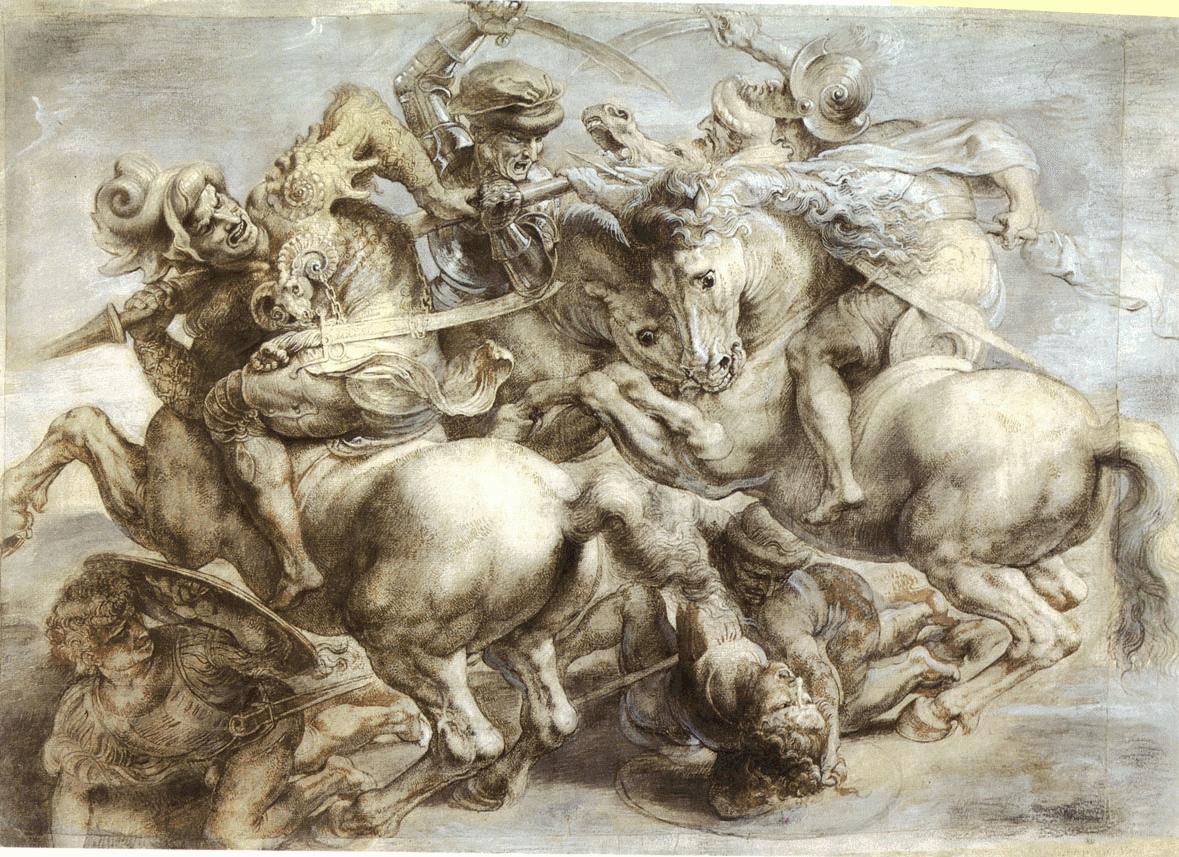
Take the ‘Battle of Anghiari‘ for instance, painted between 1503-1506 by old master extraordinaire Leonardo da Vinci. Also referred to as “The Lost Leonardo“, this is an artwork that we only know about thanks to the process of studying the masters. This fresco should have been Leonardo’s redemption piece after the failings he suffered with “The Last Supper” but unfortunately, before too long the piece was lost.
Before the ‘Battle of Anghiari‘ was lost, however, it remained on the wall for several decades and in that time it received a good many visitors, some of those viewers were artists themselves and blown away by the immensity and power of the piece, they decided to study it.
One such study was created in 1553 by a man named Lorenzo Zacchia and he managed to get that done in good time as the entire piece was lost by 1560 and painted over.
40 plus years after the loss of Leonardo’s unfinished but still incredible ‘Battle of Anghiari‘, another amazing master artist appears on the scene and he manages to study the masterful but lost work of Leonardo da Vinci by working from the engraving of Lorenzo Zacchia’s study.
That man was Peter Paul Rubens, and he created the piece of art that we now see and think of as Leonardo’s ‘Battle of Anghiari‘.
All of this is from studying a master who had studied a master. Very inspiring.
Tools And Equipment Necessary For A Master Study
There really are no hard and fast rules for this, you can study a sculpture or an oil painting using nothing more than a pencil or a biro, so the best advice for someone stuck on what tools to use is simply, to sharpen a pencil.
By sharpening a pencil and getting that ready, no matter what medium you intend on using for your study, you can work out a quick sketch which will break the fearful and daunting barrier of the blank surface.
It also depends on what you want to gain from the master study in question, figuring that out before you start will help you to choose the medium best suited to your needs.
In the quest to find inspiration your best bet is to just get stuck in and start before the procrastination starts setting in, with that in mind it’s best to sometimes just grab a sheet of paper and a pencil and get to work.
How To Choose An Old Master To Study
You can always think of an artist whose work inspires you and makes you want to create something, an artist whose style you love and whose techniques draw you in at a glance. Hone in on those artists that give you those feelings and appeal to your sense of art, study them and learn what it is you like about them.
It’s also a good idea to study works of artists that don’t appeal to you too as a way to learn more, this can also be a great way to get inspired too as you’ll find yourself being a lot less precious about a work that you’re not overly keen on, and you’ll appreciate the work you do love to create a lot more afterwards.
Where To Find The Old Master Works To Study
There are so many places to find old master art to study that a comprehensive list and in-depth analysis could fill books let alone a small section of an article on finding inspiration.
For the sake of this article then, I’ve compiled a short list, each of these has a vast amount of opportunity for discovery and inspiration, and a different process of doing so.
Some places to find old master artworks to study:
8 Steps To Study The Art Of An Old Master Artist
- Choose an old master artwork to study
- Set goals for what you wish to gain from the study
- Get your tools and equipment ready
- Conduct a quick, rough pencil or pen sketch, keep it between 2 and 20 minutes
- Start your main study of the artwork
- Continuously ask questions about the piece you’re studying and the techniques of the master artist
- Step back and examine both the master artwork and your own study
- Think about how what you’ve learned can be used to inform your own art
How Studying The Masters Can Inform Your Personal Artwork
Going back to our earlier example of one of the greatest students of the old masters ever to have lived, Peter Paul Rubens, his study of Leonardo’s ‘Battle of Anghiari‘ went on to inform his artwork of his in a very impactful way.

Now you don’t need to spend too much time looking at this piece to realise that Rubens was still being influenced by his study of the old master Leonardo da Vinci a good 12 or so years after working on it. This is in my mind the greatest example of the application of the knowledge and inspiration gained from studying the masters.
Another example of this in action is a piece that I recently created which was informed by a recent master study –


In this example here I used the knowledge, idea and inspiration gleaned from my study of Hunt’s ‘Seated Girl’ to inform a personal artwork that I had been playing around with in the sketchbook for a while, not only did I find a massive creative inspiration boost by studying an old master, I also produced a new original Geisha artwork that I could be happy with.
Explore The Art Of Storytelling. Unlock Your Inner Storyteller.
Unlock your inner storyteller by Joining The Journey with me in exploring the art of storytelling; discovering new worlds, stories and techniques for capturing a narrative, creating moments and bringing stories to life.
 Sketches & Storytelling - Art, Illustration, and Storytelling
One thought on “Studying The Masters To Find Creative Inspiration”